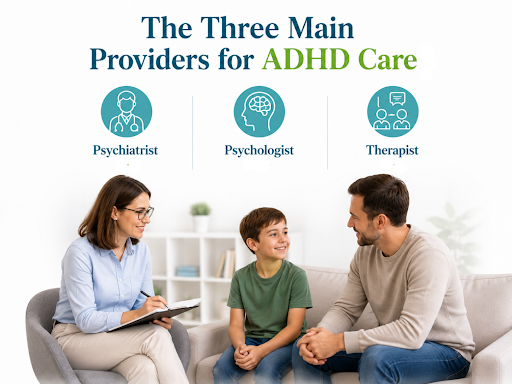
See a psychiatrist if you need medication, a psychologist if you need formal testing, and a therapist if you need behavioral support and coping strategies. Many people benefit from working with more than one provider. The right choice depends on your symptoms, treatment goals, age, and whether medication is being considered. In many cases, the most effective ADHD treatment involves collaboration between multiple professionals.
This guide explains exactly what psychiatrists, psychologists, and therapists do, how they help people with ADHD, and when you should consider seeing each one.
Table of Contents
- What Is ADHD, and Why Does Provider Choice Matter?
- The Three Main Providers for ADHD Care
- 1. Psychiatrist — For Diagnosis and Medication Management
- 2. Psychologist — For Formal Testing and Assessment
- 3. Therapist or Counselor — For Behavioral Strategies and Emotional Support
- Quick Comparison: Psychiatrist vs. Psychologist vs. Therapist
- Who Should Parents Choose for a Child with ADHD?
- Who Should Adults with ADHD See?
- Signs You Should Seek Professional ADHD Help
- Questions to Ask Before Choosing an ADHD Provider
- ADHD and Co-Occurring Conditions
- What to Expect at Your First Appointment
- Connect with an Experienced Psychiatrist in Charlotte for ADHD Support
- Frequently Asked Questions About ADHD Care
What Is ADHD, and Why Does Provider Choice Matter?
ADHD (Attention-Deficit/Hyperactivity Disorder) is a neurodevelopmental condition that affects how the brain regulates attention, impulse control, and activity levels. It affects children and adults alike, and it often goes undiagnosed well into adulthood.
According to the CDC, approximately 6 million children in the United States have been diagnosed with ADHD — and adult ADHD is increasingly recognized, with the National Institute of Mental Health (NIMH) estimating that 4.4% of U.S. adults live with the condition. Many go years without a proper diagnosis or care plan.
ADHD is not a one-size-fits-all condition, which is why the type of professional you see matters deeply. The wrong provider match can delay diagnosis, result in the wrong treatment plan, or leave important needs unaddressed.
- ADHD has three primary presentations: inattentive, hyperactive-impulsive, and combined
- Symptoms can look different in adults vs. children, and in women vs. men
- Effective treatment often includes both medication and behavioral therapy
- Co-occurring conditions like anxiety, depression, and PTSD are common with ADHD
The Three Main Providers for ADHD Care
1. Psychiatrist — For Diagnosis and Medication Management
A psychiatrist is a medical doctor (MD or DO) who specializes in mental health. They are the only mental health professionals who can prescribe medication in most states.
When to see a psychiatrist for ADHD:
- You suspect you have ADHD and want an official clinical evaluation
- You've already been diagnosed and need medication (such as stimulants or non-stimulants)
- Your current medication isn't working or is causing side effects
- You have co-occurring conditions like depression or anxiety that may need medication management
What a psychiatrist does:
- Conducts a psychiatric evaluation to rule out other conditions
- Prescribes and monitors ADHD medications (e.g., Adderall, Strattera, Vyvanse, Wellbutrin)
- Adjusts dosage over time based on your response
- Coordinates care with therapists or psychologists
2. Psychologist — For Formal Testing and Assessment
A psychologist holds a doctoral degree (PhD, PsyD, or EdD) in psychology. They are trained in psychological testing and assessment, making them the go-to specialist if you need a formal ADHD diagnosis backed by standardized testing.
When to see a psychologist for ADHD:
- You need a comprehensive neuropsychological or psychoeducational evaluation
- Your school, employer, or insurance requires a formal written diagnosis
- You want to rule out learning disabilities or other cognitive conditions
- Previous assessments were inconclusive
What a psychologist does:
- Administers standardized tests for attention, memory, executive function, and IQ
- Provides a written diagnostic report you can share with schools, employers, or other providers
- May offer therapy (such as CBT) depending on their specialty
- Cannot prescribe medication (in most states), but will refer to a psychiatrist if needed
Note: Psychologists are separate from psychiatrists. If you're looking specifically for medication, a psychiatrist is your next step after a psychologist's evaluation.
3. Therapist or Counselor — For Behavioral Strategies and Emotional Support
A therapist (licensed counselor, LCSW, LPC, MFT, or similar) provides talk therapy and behavioral interventions. They don't diagnose ADHD with formal testing, and they can't prescribe medication — but they are often the most important piece of the long-term ADHD care puzzle.
Research published by the American Psychological Association (APA) consistently shows that Cognitive Behavioral Therapy (CBT) combined with medication produces better outcomes for ADHD than either treatment alone. A therapist makes that combination possible.
When to see a therapist for ADHD:
- You have an ADHD diagnosis and want practical tools to manage daily life
- You're struggling with low self-esteem, relationship problems, or emotional dysregulation connected to ADHD
- You want help building structure, routines, and organizational habits
- You're dealing with anxiety or depression alongside ADHD
What a therapist does:
- Provides Cognitive Behavioral Therapy (CBT), the most evidence-based therapy for ADHD
- Teaches time management, organizational skills, and coping strategies
- Addresses the emotional toll of living with ADHD — including shame, frustration, and burnout
- Supports family members affected by a loved one's ADHD
Quick Comparison: Psychiatrist vs. Psychologist vs. Therapist
| Psychiatrist | Psychologist | Therapist / Counselor | |
|---|---|---|---|
| Credentials | MD or DO | PhD, PsyD, or EdD | LPC, LCSW, MFT, etc. |
| Can Diagnose ADHD? | Yes (clinically) | Yes (formal testing) | No |
| Can Prescribe Medication? | Yes | No (most states) | No |
| Provides Therapy? | Rarely | Sometimes | Yes |
| Formal Testing? | No | Yes | No |
| Best For | Medication management | Assessment reports | Behavioral & emotional support |
Who Should Parents Choose for a Child with ADHD?
For children, the ideal approach often involves multiple professionals.
A common care team includes:
Pediatrician or Psychiatrist
For diagnosis and medication management.
Psychologist
For testing, assessments, and treatment planning.
Therapist
For behavioral support, emotional regulation, and family guidance.
This team-based approach ensures children receive both symptom management and long-term skill development.
Who Should Adults with ADHD See?
Adults often benefit from starting with either:
A Psychiatrist
If medication is being considered.
A Psychologist
If diagnosis is uncertain and comprehensive testing is needed.
A Therapist
If ADHD has already been diagnosed and support is needed for daily functioning.
Many adults ultimately work with both a psychiatrist and therapist for optimal results.
At Charlotte, NC, locations, NuTrans Health sees both children and adults — and our providers are experienced in recognizing how ADHD presents differently at every stage of life.
Signs You Should Seek Professional ADHD Help
Whether for yourself or your child, consider professional support if ADHD symptoms are causing:
- Academic struggles
- Workplace difficulties
- Relationship conflicts
- Chronic forgetfulness
- Severe procrastination
- Emotional outbursts
- Anxiety or depression
- Low self-confidence
- Organizational challenges
- Difficulty completing everyday tasks
Early intervention often leads to better long-term outcomes.
Questions to Ask Before Choosing an ADHD Provider
Before scheduling an appointment, consider asking:
- Do you diagnose ADHD?
- What assessment methods do you use?
- Do you treat both children and adults?
- Can you prescribe medication?
- What therapy approaches do you recommend?
- How much experience do you have treating ADHD?
- Do you work with other ADHD specialists when needed?
- Are telehealth appointments available?
- What insurance plans do you accept?
- How often are follow-up appointments scheduled?
These questions can help ensure the provider is a good fit for your specific needs.
Before seeking professional help, it can be helpful to understand the different ways ADHD presents. Learn more about the 3 Types of ADHD and how each type can affect behavior, attention, and daily functioning.
ADHD and Co-Occurring Conditions
ADHD rarely travels alone. According to the NIMH, more than 60% of people with ADHD have at least one co-occurring mental health condition — making comprehensive evaluation even more critical.
Common conditions seen alongside ADHD include:
- Anxiety disorders — worrying excessively, difficulty unwinding, tension
- Depression — low motivation, hopelessness, often mistaken for ADHD lethargy
- PTSD or trauma — trauma can mimic ADHD and complicate treatment
- Learning disabilities — dyslexia, dyscalculia, processing disorders
- Sleep disorders — difficulty falling asleep or waking, common in ADHD
- Substance use disorders — higher rates of self-medication behavior
This is why a thorough evaluation matters. A good provider won't just treat the ADHD — they'll look at the whole picture.
For individuals experiencing overlapping symptoms, seeking professional Anxiety, Depression, ADHD and PTSD treatment can lead to more accurate diagnoses and better treatment outcomes.
What to Expect at Your First Appointment
No matter which provider you start with, here's what to expect:
Before your appointment:
- Gather any previous records, report cards, or prior evaluations
- Note your top 3–5 symptoms and how they impact your daily life
- Write down any medications you currently take
During your first visit:
- You'll be asked about your history — childhood, school, relationships, work
- Expect questions about sleep, mood, focus, and habits
- Don't downplay your symptoms — be honest about the full picture
After your appointment:
- You may be referred to additional providers
- A treatment plan will be discussed, which may include medication, therapy, or both
- Follow-up appointments are typically scheduled every 2–4 weeks initially
At NuTrans Health, your first psychiatric intake is a 60-minute session designed to give your provider a full picture — not a rushed 15-minute check-in. We want to get it right from the start.
Connect with an Experienced Psychiatrist in Charlotte for ADHD Support
If you or your child is struggling with ADHD symptoms, professional help is available. At Nutrans Health, our experienced psychiatrists in Charlotte provide comprehensive ADHD evaluations, personalized treatment plans, counseling, and ongoing support to help individuals improve focus, manage emotions, and build practical life skills.
Whether you're seeking an ADHD diagnosis, therapy, or medication management, our compassionate mental health team is here to help.
Contact Nutrans Health today and take the first step toward better mental health and long-term success.
Frequently Asked Questions About ADHD Care
Should I See a Psychologist or Psychiatrist First?
If you are seeking medication management or suspect you may have ADHD, a psychiatrist is often a good starting point. If formal testing or a comprehensive assessment is needed, a psychologist may be recommended.
Is medication always required for ADHD?
No. Some people manage ADHD effectively with therapy, coaching, and lifestyle strategies alone. Many do best with a combination of medication and behavioral support.
Can a Primary Care Doctor Diagnose ADHD?
Yes, a primary care doctor can diagnose and treat ADHD in some cases. However, if symptoms are complex or involve conditions such as anxiety, depression, or learning disorders, a psychiatrist or psychologist may be recommended for a more comprehensive evaluation.
Does insurance cover ADHD evaluations?
Most insurance plans cover psychiatric evaluations and therapy. Formal neuropsychological testing by a psychologist may have different coverage. NuTrans Health accepts most major insurance plans — contact us to verify your benefits.
Can ADHD Be Misdiagnosed?
Yes. Conditions such as anxiety, depression, PTSD, sleep disorders, and learning disabilities can sometimes mimic ADHD symptoms. A comprehensive evaluation helps ensure an accurate diagnosis.
What Is the Difference Between ADHD Testing and ADHD Therapy?
ADHD testing focuses on diagnosis and assessment. ADHD therapy focuses on helping individuals manage symptoms, develop coping strategies, improve organization, and address emotional challenges associated with ADHD.
Medically reviewed by Shirley Carrenard-McDowell, PMHNP, Nutrans Health, to ensure accuracy and alignment with current evidence-based practices for ADHD evaluation, diagnosis, and treatment.
Related Blogs
Mental Health Services in Raleigh NC and How AI Improves It
Mental Health Services in Raleigh NC and How AI...
Read MoreMental Health Counseling and Workplace Stress in Raleigh
Mental Health Counseling and Workplace Stress in Raleigh The...
Read MoreTeletherapy vs. In-Person Counseling: Which One is Right for You?
Teletherapy vs. In-Person Counseling: Which One is Right for...
Read More