ADHD often comes with a familiar feeling: you can tackle big, high pressure problems, think creatively, and move fast when something grabs your interest, yet you cannot start a two minute task like replying to a message, putting laundry away, or booking an appointment. To people around you, it may appear as laziness or a lack of willpower. In reality, it can feel like being trapped behind an invisible wall, pushing with everything you have and barely moving forward.
This disconnect, being capable and intelligent yet struggling with small everyday tasks, is one of the most misunderstood parts of ADHD. It is not a character flaw. It is not a moral failing. It is a brain difference that affects self management systems: starting, sustaining, switching, and completing tasks, especially when those tasks are boring, unclear, emotionally loaded, or not immediately rewarding.
This article breaks down why small things can feel so hard with ADHD, what’s really going on in the brain and nervous system, and practical strategies that reduce friction without requiring you to become a different person.
Table of Contents- ADHD Isn’t a Focus Problem It’s a Self Management Problem
- Why Simple Tasks Feel Emotionally Overwhelming
- Why Your Brain Hits a Block Even When You Want to Start
- Why You Cannot Rely on Willpower Alone With ADHD
- Why “Simple” Tasks Are Not Actually Simple
- How Perfectionism Makes Starting Feel Impossible
- Why Consistency Feels So Hard With ADHD
- How Stress and Shame Make ADHD Symptoms Worse
- Why “Just Use a Planner” Often Doesn’t Work
- How to Make Daily Tasks Feel More Manageable
- When to Consider Medication, Therapy, or Coaching
- How to Explain This to Others (Without Over-Defending Yourself)
- What Productivity Really Looks Like With ADHD
- A 10 Minute ADHD Friendly Daily Reset That Actually Works
- You Are Not Broken Your Brain Needs Different Inputs
- NuTrans Health Supports You in Managing ADHD
ADHD Isn’t a Focus Problem It’s a Self Management Problem
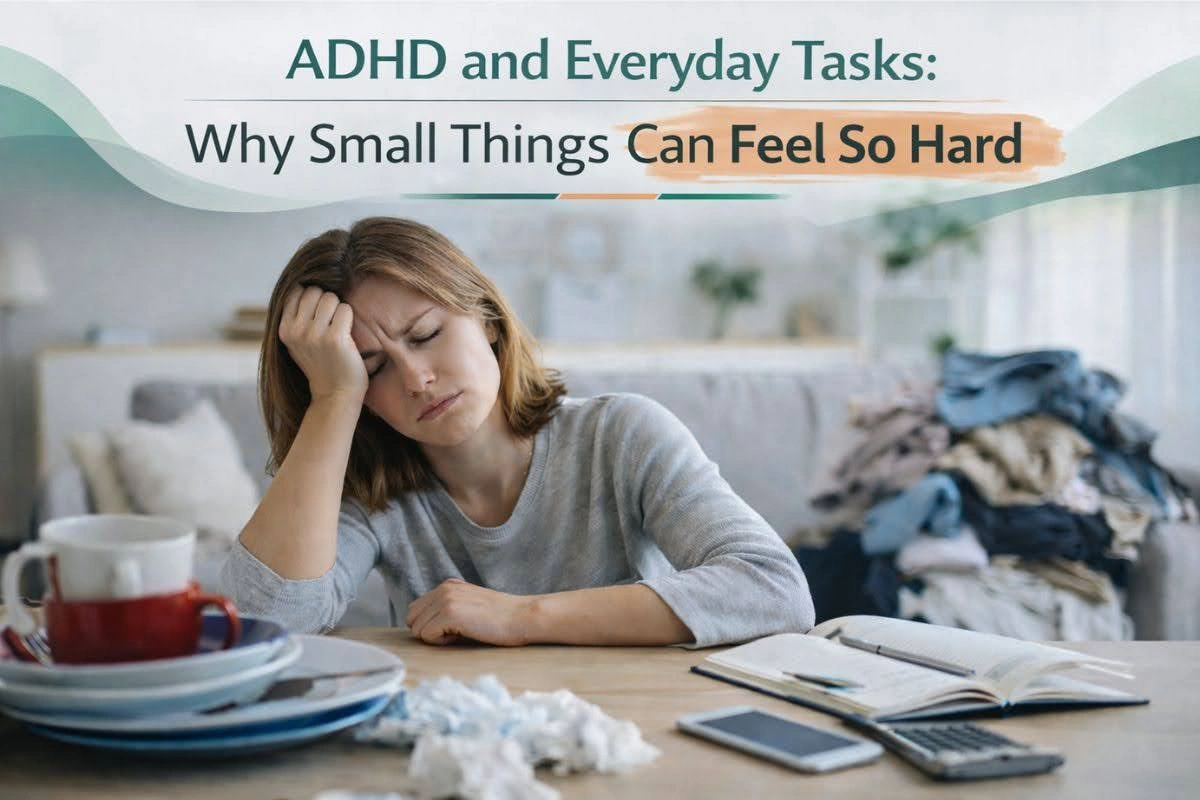
ADHD is often framed as an inability to pay attention, but many people with ADHD can focus extremely well, sometimes too well, when something is stimulating. A more accurate description is that ADHD affects regulation. It affects the ability to regulate attention, motivation, emotion, energy, and behavior over time.
Everyday tasks such as emails, dishes, planning, hygiene routines, and paperwork are self management tasks. They require you to:
- decide what matters right now
- start without urgency
- hold steps in mind
- resist distractions
- tolerate boredom
- switch between tasks
- finish and clean up
- remember to do it again later
ADHD can make any one of those steps harder. And if you’ve ever felt “stuck” despite wanting to do the thing, you’ve experienced a core feature: intention doesn’t automatically translate into action.
Why Simple Tasks Feel Emotionally Overwhelming
One reason small tasks feel disproportionately hard is because they often are not just tasks, they are triggers.
If you’ve repeatedly struggled with simple responsibilities, you may have accumulated a “Wall of Awful”: layers of emotional associations like shame, dread, frustration, and fear of failure. Then the task “reply to email” doesn’t feel neutral; it feels like:
- “I’m behind.”
- “I’ll say the wrong thing.”
- “I should’ve done this earlier.”
- “This is proof I can’t handle adulthood.”
That emotional weight can shut down your ability to start. Not because you are being dramatic, but because your brain is trying to protect you from discomfort.
When people say, “Just do it, it’s easy,” they’re assuming the task is emotionally neutral. For many people with ADHD, it isn’t.
Why Your Brain Hits a Block Even When You Want to Start
A key explanation is executive dysfunction, which is difficulty with the brain’s management system. Executive functions are not a single skill. They are a cluster of abilities that help you direct behavior toward goals.
Here are executive functions that commonly affect everyday tasks:
1) Task Initiation (Starting)
Starting is often the hardest part. Not because you do not care, but because your brain struggles to shift from “thinking about doing it” into “doing it.”
2) Working Memory (Holding Steps in Mind)
A task like “clean the kitchen” is actually dozens of micro-steps. ADHD working memory challenges can make it feel like trying to juggle fog.
3) Planning and Prioritizing
Choosing what to do first can be paralyzing. Without a clear internal prioritization signal, everything feels equally urgent or equally impossible.
4) Sustained Attention (Sticking With It)
Tasks that don’t provide stimulation can feel physically uncomfortable. You’re not “being picky.” Your brain is under-aroused and seeks novelty.
5) Inhibition (Resisting Distractions)
The ADHD brain often notices everything. A notification, a thought, a sound, a random curiosity, and suddenly you are reorganizing your photo folder.
6) Task Switching (Transitioning)
Switching tasks takes mental energy. That’s why starting one thing can derail your whole day, or stopping a fun thing can feel painful.
7) Self-Monitoring (Tracking Time and Progress)
Many people with ADHD have time blindness, which is difficulty sensing time passing, predicting how long something will take, and noticing when they are getting off track.
Each of these bottlenecks can turn a “small task” into a complex project.
Why You Cannot Rely on Willpower Alone With ADHD
Motivation in ADHD runs on interest, urgency, novelty, and reward. A common ADHD experience is: “If I don’t feel like doing it, I can’t do it.”
This isn’t about being spoiled. It’s about how motivation is triggered. Many ADHD brains respond less to distant or abstract rewards (“I’ll feel better later”) and more to immediate drivers.
Four drivers that often unlock action:
- Interest: It’s engaging, meaningful, or fun.
- Urgency: There’s a deadline or immediate consequence.
- Novelty: It’s new or different.
- Reward: There’s a quick payoff.
Everyday tasks often have none of these. They are repetitive, low-reward, and have consequences that are delayed. So your brain doesn’t supply the “go” signal reliably, even when you logically want to do the thing.
Why “Simple” Tasks Are Not Actually Simple
Many daily responsibilities seem simple on paper but contain hidden steps that are executive-function heavy.
Take “make an appointment.” Hidden steps might include:
- find the right provider
- locate your insurance info
- call during business hours
- wait on hold
- answer questions quickly
- negotiate times
- add it to your calendar
- arrange transport
- remember paperwork
If you have ADHD, each step can be a snag point. Your brain senses the complexity and responds with avoidance. Then it looks like procrastination, but it’s often overwhelming.
How Perfectionism Makes Starting Feel Impossible
ADHD is frequently paired with perfectionism, often as a coping strategy. After years of being told you are careless or inconsistent, you may start believing you must do things perfectly to avoid criticism.
So instead of “write a quick reply,” it becomes:
- “I need the perfect wording.”
- “I should read the whole thread first.”
- “What if they misunderstand?”
This turns small tasks into high-stakes performances, which makes your nervous system resist starting.
All-or-nothing thinking also shows up as:
- “If I can’t do a full workout, there’s no point.”
- “If I can’t clean the whole room, why start?”
But ADHD often requires the opposite approach: partial progress counts.
Why Consistency Feels So Hard With ADHD
Many people with ADHD don’t have a steady, predictable energy supply. They have spikes: bursts of high focus followed by crashes. This can make it hard to build routines based on consistency.
You might have mornings where you can do everything and afternoons where you can’t do anything. Or weeks of productivity followed by a slump. The inconsistency is frustrating, but it’s also a clue: your system responds strongly to stimulation, emotion, sleep, stress, and context.
That’s why strategies based on “just be disciplined” fail. You’re not a robot. You need supports that work with variability.
How Stress and Shame Make ADHD Symptoms Worse
Stress narrows attention and increases avoidance. Shame increases stress. And ADHD symptoms worsen under stress. That creates a loop:
- Task is delayed
- Consequences pile up
- Stress rises
- Brain becomes more avoidant
- Task feels even harder
- Shame increases
- Repeat
Breaking this loop is less about forcing yourself and more about reducing threats in the environment, both internally and externally.
Why “Just Use a Planner” Often Doesn’t Work
Planners can help, but they often fail for ADHD because they assume:
- you’ll remember to check them
- you’ll estimate time accurately
- your motivation will be consistent
- you’ll prioritize rationally
- you won’t avoid emotionally loaded items
Many people with ADHD have bought multiple planners and felt guilty each time it didn’t “stick.” The issue isn’t that you didn’t try hard enough. It’s that the tool didn’t match your brain.
Effective supports are usually:
- external (visible cues)
- immediate (in your face at the right time)
- simple (low maintenance)
- rewarding (small dopamine boosts)
- forgiving (works even when you miss a day)
How to Make Daily Tasks Feel More Manageable
The goal isn’t to become someone who loves chores. The goal is to reduce friction and increase follow-through.
1) Make Tasks Smaller Than You Think Necessary
If your brain resists “clean the kitchen,” try:
- “throw away trash for 2 minutes”
- “clear one corner of the counter”
- “wash five items”
Smaller tasks reduce overwhelm and lower the emotional barrier to starting. Often, starting creates momentum.
Tip: Give yourself permission to stop after the micro-task. That removes the fear of being trapped.
2) Use “Body Doubling”
Body doubling means doing tasks while another person is present (in person or virtually). Many ADHD brains regulate better with social presence.
- call a friend while you fold laundry
- work in a coworking session
- sit in the same room as a partner while you do admin tasks
This is not dependence, it is evidence informed support that provides structure, accountability, and stimulation.
3) Create Artificial Urgency (Without Panic)
Deadlines help ADHD brains, but panic isn’t sustainable. Try gentle urgency:
- set a 10-minute timer and race it
- “I’ll do this before my coffee gets cold”
- schedule a short check-in with someone (“I’ll message you when it’s done”)
The trick is to simulate urgency without shame.
4) Lower the “Activation Energy”
Make the first step ridiculously easy. Examples:
- keep cleaning wipes visible on the counter
- place your meds next to your toothbrush
- keep a laundry basket where clothes actually land
- store bills and paperwork in one open bin, not a closed file system
- pre-write email templates for common responses
ADHD-friendly environments reduce reliance on memory and willpower.
5) Externalize Reminders in the Real World
Out of sight is often out of mind. Better than “I’ll remember”:
- sticky notes at eye level
- phone alarms with specific labels (“Start shower,” not “Reminder”)
- calendar events with travel time
- a whiteboard near the door
- placing items in your path (keys on top of your shoes)
6) Use the “If-Then” Script for Transitions
Transitions are hard. Use simple scripts:
- “If I finish eating, then I put the dish in the sink immediately.”
- “If I sit at my desk, then I open the document first.”
- “If I get into bed, then I plug in my phone across the room.”
Automation beats decision-making.
7) Pair Boring Tasks With Stimulation
This is not cheating, this is design.
- podcasts while cleaning
- music while cooking
- audiobooks while commuting
- a “fun drink” while doing emails
- fidget tools during meetings
You’re adding dopamine to tasks that don’t naturally provide it.
8) Use “Good Enough” Standards on Purpose
Choose minimum standards ahead of time. Examples:
- “A shower counts even if it’s short.”
- “Brushing for 30 seconds is better than not at all.”
- “Replying with a simple sentence is acceptable.”
- “Clearing one surface counts as tidying.”
Perfectionism steals momentum. Good-enough standards create it.
9) Build Routines Around Anchors, Not Time
Time-based routines (“At 7:00 I do X”) can fail when your day shifts. Anchor-based routines are tied to events:
- after breakfast → meds
- after shower → deodorant + clothes laid out
- after logging into work → check top 3 tasks
- before bed → plug phone + set clothes
Anchors are more reliable than clocks for many ADHD brains.
10) Separate “Planning” From “Doing”
Planning can feel productive and also become avoidable. Try:
- 5 minutes planning max, then action
- write the first physical step only
- choose one task for “now,” not ten tasks for “later”
If you find yourself making the perfect system, ask: What is the smallest action I can do in the next 60 seconds?
When to Consider Medication, Therapy, or Coaching
Strategies help, but sometimes you need more support, and that is okay.
- Medication can improve attention regulation and task initiation for many people.
- CBT adapted for ADHD can help with shame, avoidance, and systems.
- ADHD coaching can support planning, accountability, and customized routines.
- Occupational therapy can help with daily functioning and sensory needs.
If you suspect you have ADHD or find that daily functioning feels consistently overwhelming, speaking with a qualified professional can be an important step. Seeking support does not mean you are failing. It means you are choosing to build tools, structure, and understanding that work with your brain rather than against it.
To better understand when medication may become an important part of treatment, explore our guide on When Are Medicines Necessary for Mental Health? Signs & Guidance.
How to Explain This to Others (Without Over-Defending Yourself)
You may need language that doesn’t invite debate. Here are some options:
- “ADHD affects task initiation and time management. I’m working on strategies that help me start.”
- “It is not about wanting it, I do want it. My brain struggles with switching into action, especially for boring tasks.”
- “I do best with clear steps and accountability. If you can help me break it down, I can follow through.”
- “Pressure helps me start, but I’m trying to use healthier supports than last-minute panic.”
You don’t owe anyone a dissertation. But you deserve understanding.
What Productivity Really Looks Like With ADHD
People with ADHD often measure themselves by neurotypical standards: consistent output, clean routines, linear progress. That’s a rigged game.
A healthier measure is: Did I create conditions that made action more likely?
Did you set a timer? Ask for body doubling? Make the first step smaller? Reduce friction?
That is real progress. ADHD management is less about heroic willpower and more about smart scaffolding.
A 10 Minute ADHD Friendly Daily Reset That Actually Works
Try this simple repeatable routine that supports you without adding pressure:
- Drink water (or take one deep breath—seriously)
- Set a 10-minute timer
- Pick one area (desk, sink, bed)
- Do only “obvious” actions: trash, dishes, laundry
- Stop when the timer ends
- Write your top 1–3 tasks on a sticky note
- Do the first step of task #1 (open doc, dial number, write subject line)
This works because it’s short, concrete, and transition-friendly.
You Are Not Broken Your Brain Needs Different Inputs
When small things feel hard, it is tempting to conclude you are incapable. But ADHD does not erase your abilities, it scrambles access to them, especially in low stimulation, high friction situations.
You are allowed to use supports. You are allowed to simplify. You are allowed to do things in a way that looks unconventional if it works.
One idea to take from this article is this: Make the task easier, not yourself harder. That shift toward compassion, design, and realistic support is often what turns “I can’t” into “I can, with the right setup.”
Life changes can significantly impact emotional well-being, and learning how to navigate them effectively is essential. Explore How Life Transitions Can Stir Anxiety and Practical Ways to Cope to better understand the connection and discover healthy coping strategies.
NuTrans Health Supports You in Managing ADHD
Small tasks should not feel like mountains. When they do, it is not a personal failure. It is a sign that your brain needs the right support, structure, and understanding. ADHD is not about trying harder. It is about working smarter with how your brain functions.
With the right tools, compassionate strategies, and professional guidance, everyday life can become more manageable and less overwhelming.
At NuTrans Health, we provide comprehensive outpatient treatment for anxiety, depression, ADHD, and PTSD, offering personalized care designed to support the unique ways each brain operates. We believe mental wellness starts with understanding, not judgment. If ADHD or other mental health challenges are affecting your daily functioning, you do not have to navigate them alone. The right support can help you build systems that fit your brain, strengthen emotional resilience, and restore confidence in your ability to manage everyday life.
Individuals looking for a compassionate Therapist in Charlotte, NC can find personalized, evidence based care at NuTrans Health. Our experienced clinicians work closely with each client to create practical strategies that align with their strengths, helping them move forward with clarity, confidence, and long term emotional stability.
Related Blogs
Mental Health Services in Raleigh NC and How AI Improves It
Mental Health Services in Raleigh NC and How AI...
Read MoreMental Health Counseling and Workplace Stress in Raleigh
Mental Health Counseling and Workplace Stress in Raleigh The...
Read MoreTeletherapy vs. In-Person Counseling: Which One is Right for You?
Teletherapy vs. In-Person Counseling: Which One is Right for...
Read More