Researchers across psychology, neuroscience, and public health have spent decades investigating what sports fandom actually does to the people who practise it. And the findings reveal that sports are far more than mere entertainment.
Being a sports fan, when engaged thoughtfully, can contribute positively to mental health. It can reduce loneliness, build community, create a sense of purpose, provide emotional outlets, enhance self esteem, and even help people through some of the most difficult periods of their lives. Sports fandom also has its complexities and potential downsides, which we will also explore honestly. But the evidence increasingly suggests that for many people, following a team is not an escape from life, it is a meaningful part of living it.
This article explores the psychology behind sports fandom, examining what the research reveals about its impact on mental wellbeing and how to engage with it in ways that maximize the benefits while avoiding the potential downsides.
Table of Contents
- Mental Health Benefits of Being a Sports Fan
- The Psychology of Sports Fandom and Belonging
- The Psychology of Collective Joy: What Winning Does to a Community
- Identity, Purpose, and the Sense of Mattering
- Sport Fandom as Emotional Education
- Physical and Lifestyle Benefits of Fandom
- Sports Fandom and Mental Health in Hard Times
- Can Sports Fandom Harm Mental Health?
- How to Engage With Sport Fandom for Your Mental Health
- The NuTrans Health Approach to Mental Wellbeing
Mental Health Benefits of Being a Sports Fan
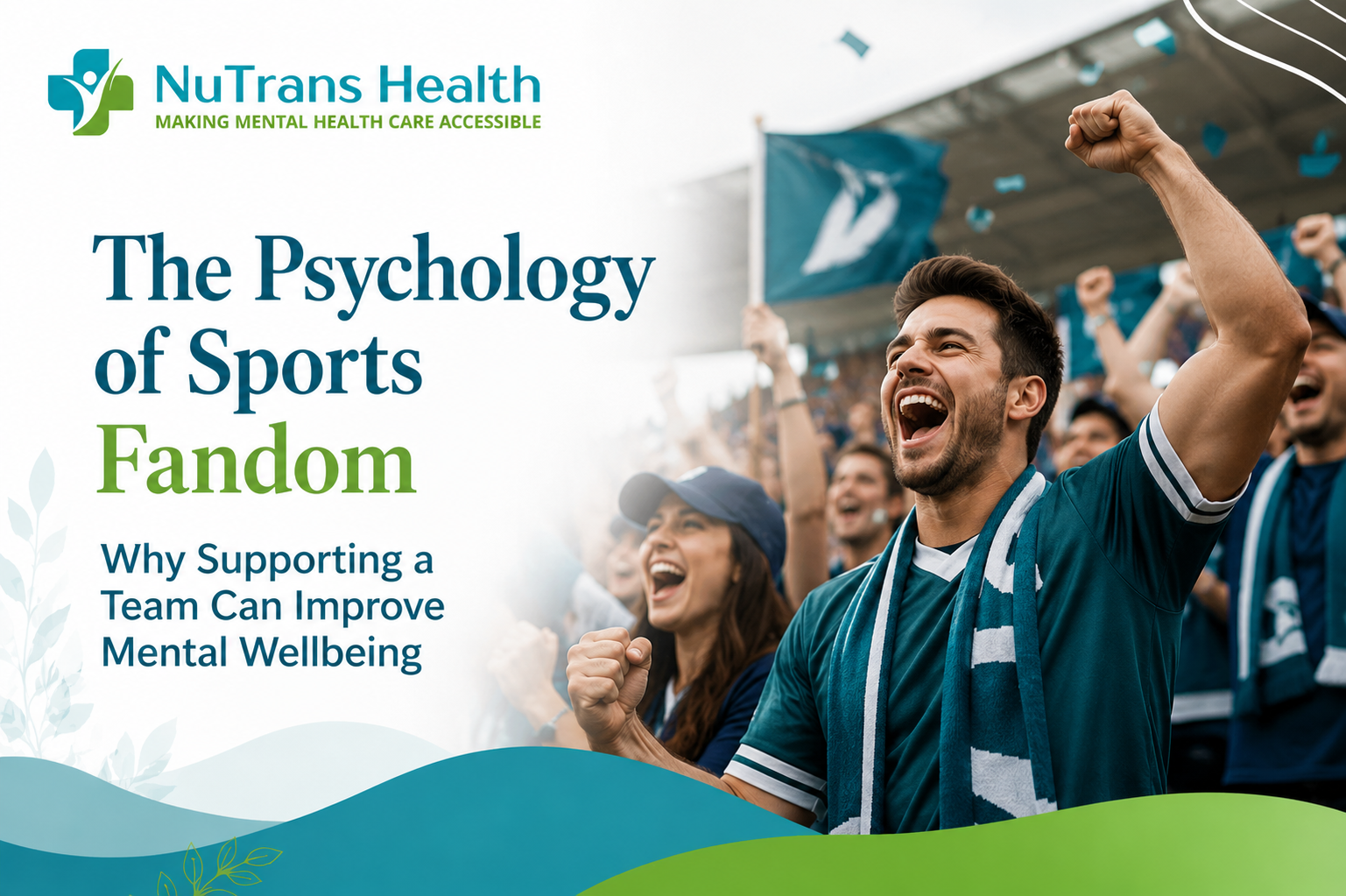
Research suggests that sports fandom offers meaningful psychological and social benefits.
The Psychology of Sports Fandom and Belonging
One of the most well established findings in mental health research is that social connection is not a luxury, it is a biological necessity. Loneliness and social isolation are associated with increased risk of:
- Depression
- Anxiety
- Cardiovascular disease
- Premature death
The research of social neuroscientist John Cacioppo consistently demonstrated that chronic loneliness is as damaging to health as smoking fifteen cigarettes a day.
Sports fandom is, at its core, a mechanism for belonging. Supporting a team immediately grants you membership in a community, one with:
- Shared rituals
- Shared language
- Shared history
- Shared hope
- Shared heartbreak
Whether you are in a stadium of eighty thousand people chanting the same song, or sitting alone in a pub surrounded by strangers who suddenly become allies when the opening goal is scored, fandom creates what sociologists call a sense of collective identity.
Psychologist Daniel Wann at Murray State University has spent much of his career studying the relationship between sports fandom and mental health. His research consistently finds that highly identified sports fans, those with a deep sense of connection to their team, report significantly higher levels of social wellbeing, lower levels of loneliness, greater self esteem, and more positive emotional states than non fans or low identification fans.
Importantly, Wann's research suggests that it is not simply watching sport that produces these benefits, but the social identification, the sense of truly belonging to the group, that drives the mental health effects.
This matters because it means fandom is not a passive activity. It is a social practice that, when fully engaged with, provides genuine community membership in a world where many adults struggle to find a strong sense of community. Neighbourhood ties have weakened. The pub quiz has moved online. A sports team, however, remains one of the few contexts in which adults gather around a shared passion and build relationships that can last for years, even generations.
The Psychology of Collective Joy: What Winning Does to a Community
There is something uniquely powerful about experiencing joy collectively. Developmental psychologist Barbara Fredrickson's broaden and build theory of positive emotions proposes that positive emotional experiences do more than feel good in the moment, they literally broaden a person's awareness and build lasting psychological and social resources. Joy, in other words, is generative. It builds capacity.
When a sports team wins, the joy is shared, and shared joy is amplified in ways that private joy is not. The phenomenon of "basking in reflected glory," first documented by social psychologist Robert Cialdini, describes the way people's self esteem and positive self perception reliably increase following victories by a team they identify with.
Fans' brains literally experience winning vicariously. Neuroimaging studies have shown that watching a favoured team succeed activates similar reward pathways to those activated by personal achievement.
This has real world mental health implications. Following a successful team or a sporting event that produces positive shared experiences can lead to:
- Increased community cohesion
- Higher reported wellbeing
- Greater social trust
Examples include:
- A World Cup summer
- A championship run
- An Olympic Games
The 2012 London Olympics, for example, were associated with documented increases in British life satisfaction scores in the months following the games, an effect that researchers partly attributed to the collective joy and shared national pride the event generated.
The reverse, of course, is also true. Losses can produce genuine grief, what sports psychologists call "CORFing" (cutting off reflected failure), or, for more highly identified fans, real emotional pain that can last for days.
We will address the shadow side of fandom later. But the capacity for genuine joy, the kind that connects you to others and to something larger than yourself, is one of the most distinctive and valuable things sports fandom provides.
Identity, Purpose, and the Sense of Mattering
Human beings have a deep psychological need for what existentialist philosophers call meaning, the sense that their existence matters, that they are part of something significant, and that their story connects to a larger narrative. This need does not disappear in secular, individualised modern life; it simply goes unsatisfied more often.
Sports teams, at their best, provide their fans with exactly this kind of meaning. Following a team gives you a story that extends beyond your individual life. You are part of a history of previous triumphs and heartbreaks, legendary players and iconic moments, and traditions passed down through families and communities.
You have a role in that story. You are one of the faithful, one of those who showed up, who cared, who cheered when it was hard to keep cheering.
This is not a trivial thing.
Meaning, according to psychologist Viktor Frankl's foundational work, is one of the most powerful predictors of psychological resilience. People who feel that their lives are meaningful tend to:
- Tolerate suffering better
- Recover from trauma more effectively
- Report greater overall wellbeing
For many people, particularly men, who are statistically less likely to join community groups, maintain close friendships, or seek therapy, sports fandom fills a meaning and identity function that might otherwise go unfilled.
This is not an ideal arrangement, broader cultural shifts toward emotional openness and community participation are needed, but the reality is that for many people, their team is one of the primary contexts in which they feel deeply connected to something beyond themselves.
The sense of purpose that comes with following a team also provides structure and rhythm. There is always the next match, the next season, the transfer window, the draft, or the cup draw.
Sports impose a meaningful calendar on time, and research in positive psychology consistently shows that having things to look forward to is one of the simplest and most reliable predictors of subjective wellbeing.
The experience unfolds in a cycle:
- Anticipation before the event
- Complete absorption during it
- Reflection and discussion afterwards
The anticipation of a big game can lift mood for days beforehand; the experience of watching it provides complete absorption; the aftermath, discussing it, analysing it, replaying the key moments, extends the psychological reward further.
Sport Fandom as Emotional Education
Psychologists have long argued that one of the fundamental challenges of emotional health is developing the capacity to feel difficult emotions fully without being overwhelmed by them. Sports fandom provides something surprisingly valuable in this regard: a safe container for intense emotional experience.
In the context of a match, it is entirely socially acceptable, even expected, to feel and express emotions that in most adult contexts would be suppressed or pathologized. You can shout with fury, weep openly, feel crushing disappointment without shame, or experience euphoric joy and express it physically through jumping, singing, and embracing strangers.
These are not small things. In a culture that frequently asks adults, and especially men, to moderate, suppress, and manage their emotional expression, sport provides a sanctioned space in which the full range of human emotion is welcome.
Psychologist Susan David, in her work on emotional agility, describes the capacity to feel difficult emotions with openness and curiosity, rather than suppressing or being overwhelmed by them, as one of the most important skills for psychological health.
Sports fandom, at its best, is a repeated training ground for exactly this capacity. Fans learn to:
- Sit with tension and uncertainty
- Accept that disappointment, while real, is survivable
- Recognize that joy is worth risking heartbreak for
These are, when transferred to the rest of life, genuinely valuable emotional lessons.
There is also something important in the narrative structure of sport itself, the comeback, the underdog, the redemption arc. These narratives are not simply entertainment; they are models of resilience.
Watching a team fight back from two goals down to win, or seeing an athlete return from injury to compete again, provides what psychologists call narrative transport, an emotionally engaged experience of a story that can shift our own sense of what is possible.
Physical and Lifestyle Benefits of Fandom
Mental and physical health are not separate domains, and the physical dimensions of sports fandom deserve mention. Attending matches involves physical activity, including walking to the ground, standing and moving throughout the game, and navigating the crowd. It also involves fresh air, urban walking, and the kind of incidental physical engagement that contributes to overall health.
The social aspects of fandom also encourage activities such as:
- Pub gatherings
- Watching parties
- Sports travel
These activities get people out of their homes and into the world.
There is also the motivational dimension. Many sports fans who closely follow athletes or teams report increased motivation to exercise themselves, inspired by the performances they watch, the physical dedication they observe, and the sense of community around a sport they love.
Research on the relationship between sports spectatorship and physical activity participation is mixed but includes studies showing that highly engaged fans are more likely to participate in sport themselves, at least at the recreational level.
The disciplined seasonal structure of sport can also provide what psychologists call "temporal landmarks," significant dates and events that help people organise their sense of time, maintain future orientation, and create positive anticipation.
For people experiencing depression or low mood, which often distort time perception and reduce future orientation, having meaningful upcoming events can provide genuine psychological scaffolding. The next fixture, the cup final, or the start of a new season can all serve as important points of anticipation and structure.
Sports Fandom and Mental Health in Hard Times
Some of the most compelling evidence for the mental health value of sports fandom comes from how people use it during personal crises. Grief researchers and clinical psychologists have noted that many people coping with the loss of a loved one, divorce, job loss, or illness report that following their team provided a reliable anchor of normalcy and continuity during periods of profound disruption.
There are several mechanisms at work here.
First, sport provides distraction, not of the avoidance kind that prevents processing of difficult emotions, but of the healthy absorption kind that gives the mind temporary relief from rumination. Research on mind wandering consistently shows that ruminative thought, endlessly replaying negative events, is one of the strongest predictors of depression. Activities that produce complete absorption interrupt this cycle.
Second, sports communities provide social support during difficult times. The shared identity of fandom creates a context in which people feel comfortable reaching out, checking in, and gathering, often without the explicit emotional labour that more direct support networks can require.
For people who find it difficult to ask for help directly, the social structures of fandom can provide low threshold connections, including:
- The pre match meetup
- The post match debrief
- The WhatsApp group
These connections can be enormously sustainable.
Third, sport provides hope. The structure of sport, seasons that reset, tables that change, competitions that remain open until the final moments, is fundamentally hopeful.
No matter how bad last season was, the new season begins with every team on equal points.
This structural hopefulness is not trivial. Hope is one of the most powerful predictors of psychological resilience, and the sports fan's almost irrational optimism about what this season might bring is, in its own quiet way, a form of psychological self maintenance.
Can Sports Fandom Harm Mental Health?
Intellectual honesty requires acknowledging that sports fandom has dimensions that can harm mental health as much as help it.
The Psychological Cost of Loss
For some highly identified fans, losses produce disproportionate psychological distress, days of low mood, irritability, disrupted sleep, and social withdrawal. Research on what psychologists call "sport related depression" following significant defeats or relegations suggests this is a genuine and underappreciated phenomenon.
The same identification that makes fandom so psychologically rewarding also makes it a source of genuine vulnerability.
When Passion Becomes Unhealthy
Sports fandom can also be a vector for unhealthy behaviours, including:
- Excessive alcohol consumption
- Aggressive reactions
- Financial strain from gambling or expensive ticket prices
- The social exclusion of people who do not share the passion
In group tribalism, the intense loyalty to one's own team, can shade into hostility toward supporters of rival teams, a dynamic that at its extremes produces violence and sectarianism.
The Financial Burden of Fandom
The financial exploitation of fans by sports franchises and organisations, ever increasing ticket prices, merchandise costs, and streaming subscription requirements, can also create financial stress that offsets the psychological benefits of following a team.
None of these risks negate the genuine psychological benefits. But they underline the importance of engaging with fandom in ways that are conscious, proportionate, and grounded in its social and community dimensions. A healthy relationship with sport is built on connection and shared experience, not tribalism, excessive gambling, or identity overinvestment in results.
Sports can be a powerful source of community and resilience, but some challenges require more comprehensive care. Read the Signs You May Need a Higher Level of Mental Health Support to better understand when to seek help.
How to Engage With Sport Fandom for Your Mental Health
The research suggests that certain ways of engaging with sports fandom are more likely to produce mental health benefits than others.
Prioritise the social dimension. The mental health benefits of fandom are driven primarily by social connection and collective identity, not by passive consumption. Watch with others when possible. Join supporters' clubs, online communities, or local viewing groups. The difference between watching alone and watching with people who care as much as you do is enormous, psychologically speaking.
Balance identification with perspective. High fan identification correlates with mental health benefits, but extreme overinvestment in results, tying your self worth too closely to whether your team wins or loses, creates vulnerability to significant distress. Healthy fandom holds the passion and the perspective simultaneously. This is your team, not your identity.
Use fandom as a gateway to broader community participation. The social structures of sports fandom, supporters' clubs, amateur versions of the sport, volunteer roles at local clubs, offer pathways into wider community engagement that goes beyond spectatorship.
Be aware of the addictive dynamics of gambling. Sports betting has been deliberately designed to exploit the natural excitement of fandom, and the harms of problem gambling are well-documented and severe. If gambling is becoming part of your fandom, pay close attention to how much control you actually have over that behaviour.
At times, additional support may be beneficial alongside the activities and communities that contribute to wellbeing. Read Psychiatry or Therapy: Which Care Path Fits You Best? to better understand your care options.
The NuTrans Health Approach to Mental Wellbeing
The science of sports fandom offers a compelling and somewhat surprising message: following a team is not a trivial distraction from the serious business of life. For many people, it is one of the most consistent sources of community, joy, meaning, emotional expression, and hope available in modern life.
This does not make it a substitute for professional mental health support when that support is needed. Therapy, medication, community services, these remain the front line resources for serious mental health challenges, and fandom does not replace them.
At NuTrans Health, we understand that mental wellbeing is influenced by more than treatment alone. Meaningful relationships, supportive communities, and a strong sense of belonging all play an important role in helping people thrive. If you are facing challenges with your mental health, know that support is available. Connect with a psychiatrist in Charlotte and take a step toward resilience, balance, and long-term wellbeing.
Related Blogs
Mental Health Services in Raleigh NC and How AI Improves It
Mental Health Services in Raleigh NC and How AI...
Read MoreMental Health Counseling and Workplace Stress in Raleigh
Mental Health Counseling and Workplace Stress in Raleigh The...
Read MoreTeletherapy vs. In-Person Counseling: Which One is Right for You?
Teletherapy vs. In-Person Counseling: Which One is Right for...
Read More