Men’s mental health is often discussed in headlines after a tragedy, then quietly fades back into the background. Distress is not sudden. It accumulates over time through pressure, isolation, and experiences left unspoken.
This is the silent crisis: not that men don’t feel pain, but that many feel they cannot show it, don’t know how to name it, or worry about what it would cost them to admit they’re not okay. The result is a public health issue with real consequences. Suicide is only the most visible outcome. In the United States, the suicide rate among males is about four times higher than the rate among females. Globally, suicide is also disproportionately higher among men compared to women.
This article explores why men so often suffer in silence, what the “silent crisis” actually looks like day to day, and what helps at the individual, community, and workplace levels.
Table of Contents- What the silent crisis looks like in real life
- Why men often don’t talk about it
- The high stakes: suicide, substance use, and isolation
- Common pressures that uniquely affect men
- Why men’s mental health issues can be missed or misread
- What helps men open up (without forcing it)
- What men can do if they’re struggling (simple, realistic steps)
- What workplaces can do (because many men won’t ask)
- How to talk to a man who’s struggling (quick script)
- Redefine Strength for Men’s Mental Health
- Take the Next Step with NuTrans Health
What the silent crisis looks like in real life
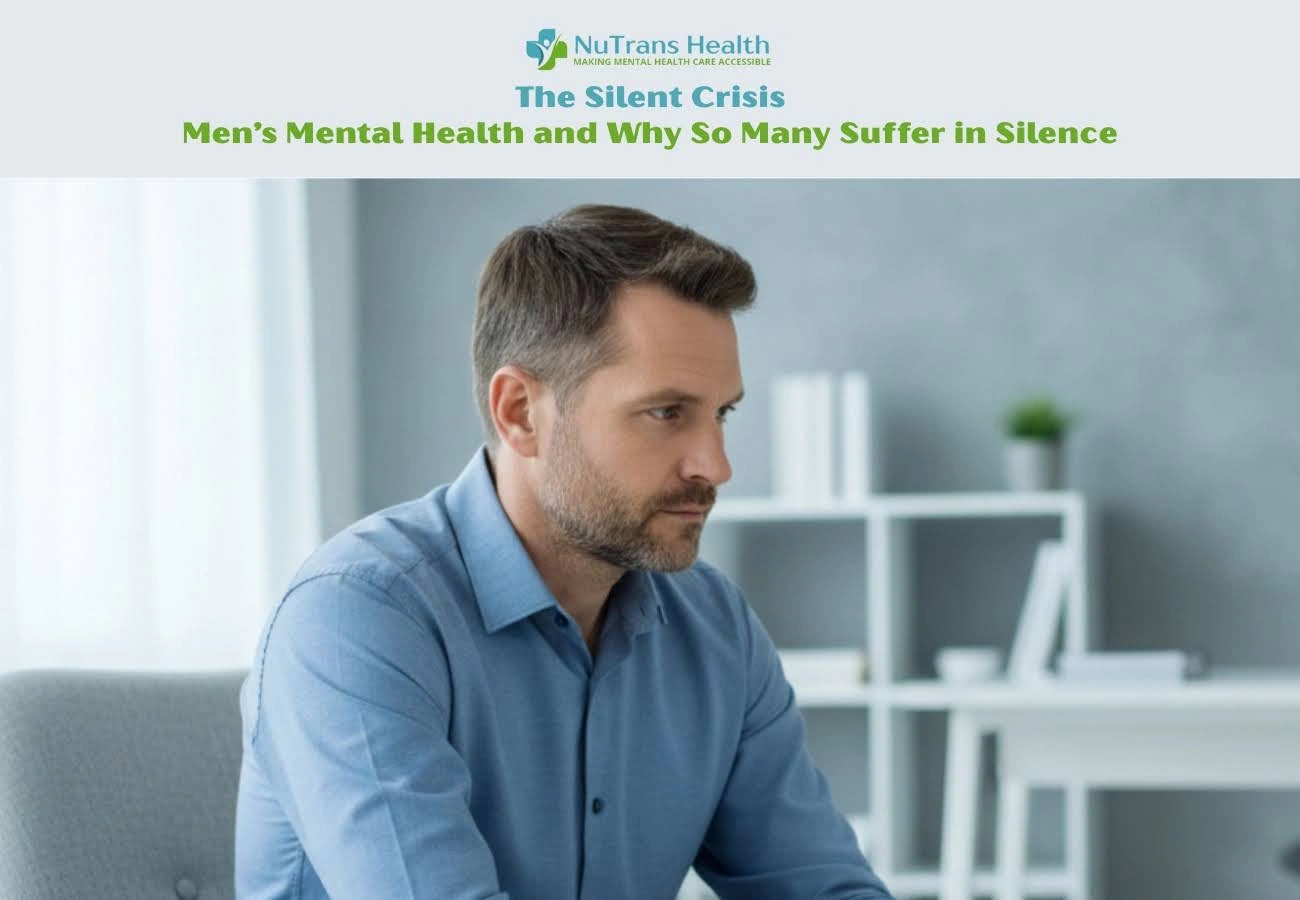
Men’s distress doesn’t always look like sadness or tears. It can show up as:
- Irritability, anger, or a shorter fuse
- Withdrawal from friends, family, and activities
- Overworking or compulsive productivity
- Increased alcohol or drug use
- Risk-taking or reckless behavior
- Physical symptoms (headaches, stomach issues, chronic tension)
- Sleep problems or constant fatigue
- Feeling emotionally “numb” or disconnected
Because these signs do not match the stereotype of depression or anxiety, they can be missed by others and even by men themselves. Many men do not think “I’m depressed.” They think “I’m failing,” “I’m falling behind,” or “I just need to push through.”
Why men often don’t talk about it
There isn’t one reason. The silence is usually built from multiple layers.
1) Social conditioning: “Be strong” becomes “be silent”
From childhood, many boys learn rules like:
- Don’t cry.
- Don’t complain.
- Handle it yourself.
- Be useful, not vulnerable.
These messages don’t always come from harsh parents. They can come from sports culture, peer groups, family expectations, or media. Over time, emotional expression can feel unsafe or “unmanly,” even when no one is explicitly shaming it.
2) Identity and self-worth tied to performance
Many men are taught directly or indirectly that their value is proven through:
- Career progress
- Financial stability
- Competence and control
- Providing for others
- Sexual performance
- Social status
When men struggle mentally, it can feel like a threat to identity, not just mood. Admitting distress can feel like admitting weakness or failure.
3) Fear of consequences
Some men avoid speaking up because they worry it will:
- Change how their partner sees them
- Hurt their reputation at work
- Affect custody or family dynamics
- Make friends uncomfortable
- Lead to judgment or “being treated differently”
Even men with supportive people around them may have internalized the belief: “If I open up, I’ll be a burden.”
4) Not having the language for it
A major barrier is simply not knowing what they feel. If you grew up without emotional vocabulary, it’s difficult to say “I’m anxious” or “I feel hopeless.” It’s easier to say “I’m tired,” “I’m stressed,” or “I’m fine.”
This is where mental health literacy matters. Studies continue to find that stigma and lower mental health literacy are linked to weaker help-seeking attitudes.
5) Help-seeking stigma and “self-reliance”
Many men value self-reliance, often a strength. The problem arises when it becomes rigid. “I must handle everything alone.” That belief can delay support until things are severe.
The high stakes: suicide, substance use, and isolation
It is important to speak carefully about suicide while also acknowledging the reality that men die by suicide at much higher rates in many countries. The reasons are complex and debated, ranging from help seeking barriers to substance use patterns and differences in method lethality, so simple explanations do not do justice.
What’s consistent across research and real-world observation is that silent suffering often overlaps with:
- Loneliness and social disconnection
- Alcohol or drug misuse as coping
- Economic stress and job instability
- Relationship strain
- Chronic sleep deprivation
- Untreated depression, anxiety, or trauma
When these pile up, men may feel trapped, especially if they believe they should handle it alone.
Anyone experiencing immediate danger or thoughts of self harm should contact local emergency services right away. In the U.S., support is available by calling or texting 988, the Suicide and Crisis Lifeline. In other countries, national crisis lines provide similar support.
Common pressures that uniquely affect men
Men are not a monolith, but some pressures show up repeatedly.
Work and “provider stress”
Work can be a source of meaning and community, but it can also become the only acceptable place to feel competent. When work becomes unstable, men may experience shame, panic, or identity collapse, especially if they define themselves through providing.
Relationship and emotional isolation
Many men rely heavily on a partner for emotional support but have fewer deep friendships. When a relationship ends or becomes strained, men can lose their main emotional outlet.
Fatherhood, custody, and “silent grief”
Men may struggle with postpartum changes, parenting stress, custody disputes, or grief, often while feeling they have to stay composed for everyone else.
Our article Postpartum Depression in Men explores this often overlooked experience in more detail.
Body image and performance pressure
Men also face appearance and performance pressure (muscularity, fitness, success signals). These can feed anxiety, disordered eating, or compulsive habits, especially when combined with social media comparison.
Trauma and “functional coping”
Some men survive trauma by becoming hyper functional, always busy, always in control, always “fine.” This can work short term until it does not.
Why men’s mental health issues can be missed or misread
Symptom expression may differ
Men may externalize distress: agitation, substance use, impulsivity, or anger. This can lead to:
- Underdiagnosis of depression/anxiety
- Mislabeling as “attitude problems”
- Missed opportunities for early support
Men may show up late
Many men seek help only when symptoms disrupt work, relationships, or physical health. That “late entry” makes recovery harder, not because men are beyond help, but because the burden is heavier.
What helps men open up (without forcing it)
Support works best when it respects dignity and autonomy.
1) Start with specific, low-pressure language
Instead of “How are you?” try:
- “You’ve seemed quieter lately, how’s your stress level been?”
- “On a scale of 1–10, how heavy has everything felt this week?”
- “Want to talk, or just want company?”
2) Normalize support as maintenance, not crisis
Many men will accept:
- coaching, performance, training, strategy before they accept:
- therapy, vulnerability, “help”
Reframe support as skill-building:
- emotional regulation
- stress management
- communication tools
- sleep recovery
- habit change
3) Offer choices
Autonomy matters. Try:
- “Would you rather talk to me, a professional, or start with something anonymous like text support?”
- “Do you want solutions, or do you want me to just listen?”
4) Make it practical
Some men open up more while doing something:
- walking
- driving
- working on a project
- gym session
Side-by-side conversation can feel safer than face-to-face.
What men can do if they’re struggling (simple, realistic steps)
Reading this and recognizing yourself does not mean you need to fix everything today. Start small.
Step 1: Name the pattern
Try a sentence like:
- “I’ve been feeling on edge for weeks.”
- “I’m not enjoying anything lately.”
- “I’m coping, but it’s getting harder.”
Naming reduces confusion and shame.
Step 2: Track basics for one week
Without judgment, note:
- sleep hours
- alcohol/caffeine intake
- workouts/movement
- social contact
- mood (1–10)
This creates clarity and helps you see what’s driving the decline.
Step 3: Choose one support channel
Options include:
- a trusted friend (even one message: “Can we talk sometime this week?”)
- a therapist or counselor
- a doctor (especially if sleep, appetite, or panic symptoms are intense)
- peer support groups (in-person or online)
Step 4: Reduce the “pressure valve” coping
Using alcohol, isolation, porn, gambling, or anger as primary ways to cope with stress often signals unmet needs rather than personal weakness. Introducing even one healthier outlet can begin to reduce pressure and restore balance.
- walking
- weights
- breathing exercises
- journaling (bullet points only)
- cold shower
- sauna
- a structured routine before bed
Step 5: If you’re in danger, treat it like an emergency
You deserve immediate support. Reach out to crisis services, emergency services, or someone who can stay with you.
What workplaces can do (because many men won’t ask)
Workplaces play a larger role than they realize, especially for men who don’t talk elsewhere.
- Train managers to recognize distress without diagnosing
- Normalize mental health days and preventive care
- Offer confidential counseling access (EAP is only helpful if people trust it)
- Encourage flexible scheduling during crises (bereavement, divorce, caregiving)
- Build cultures where asking for help doesn’t harm advancement
Even small changes, such as leaders modeling vulnerability, normalizing therapy, and checking in, can shift the entire environment.
How to talk to a man who’s struggling (quick script)
If you’re worried about a friend, brother, partner, or coworker:
-
Name what you notice
“Hey, I’ve noticed you’ve been more withdrawn lately.” -
Express care without pressure
“I care about you. No pressure to talk, but I’m here.” -
Offer a next step
“Want to grab a walk this week?” or “If things feel heavy, I can help you find a therapist or a support line.” -
If you’re worried about immediate safety, ask directly
If you suspect someone may be suicidal, it’s okay to ask directly if they’re thinking about harming themselves. If the answer is yes, seek immediate help and don’t leave them alone.
Redefine Strength for Men’s Mental Health
Men’s mental health improves when we replace “man up” with something more honest:
- You can be strong and still need support.
- You can be competent and still struggle.
- You can protect your family better when you’re well.
- You don’t have to hit rock bottom to deserve help.
- The silent crisis is not inevitable. It is cultural, relational, and solvable, especially when men are met with practical support, respect, and options that preserve dignity.
You can also explore How to Encourage the Men in Your Life to Seek Therapy and Support Their Well-Being for practical next steps.
Take the Next Step with NuTrans Health
Men’s mental health does not improve through silence, endurance, or pushing through alone. Meaningful change begins when struggle is recognized early and met with practical, compassionate support.
At NuTrans Health, we understand that mental well-being is shaped by more than thoughts alone. It is influenced by nervous system regulation, nutrition, lifestyle habits, stress load, and the environments people live and work in. Our approach to Mental Health Counseling focuses on addressing these factors together, helping individuals build resilience in sustainable, evidence-based ways.
Seeking support is not a sign of weakness. It is a step toward stability, clarity, and long-term health. Whether you are navigating stress, emotional exhaustion, or feeling disconnected from yourself or others, support is available.
Related Blogs
Mental Health Services in Raleigh NC and How AI Improves It
Mental Health Services in Raleigh NC and How AI...
Read MoreMental Health Counseling and Workplace Stress in Raleigh
Mental Health Counseling and Workplace Stress in Raleigh The...
Read MoreTeletherapy vs. In-Person Counseling: Which One is Right for You?
Teletherapy vs. In-Person Counseling: Which One is Right for...
Read More