If you are parenting a child with ADHD, you know how quickly everyday tasks can turn into daily struggles. Difficulties with self regulation, time management, and transitions often make mornings, homework, and bedtime especially challenging.
The good news is that predictable, well structured routines are one of the most effective ways to reduce ADHD related conflict. When children know what to expect, they can navigate the day with greater confidence, making family life calmer, more organized, and less stressful for everyone.
This guide will walk you through exactly how to build those routines, step by step, in a way that actually works for children with ADHD, not just in theory, but in the real, complicated, unpredictable rhythm of daily family life.
Table of Contents
- Why Routine Works Differently for ADHD Brains
- What Makes an ADHD Routine Actually Work?
- The 3 Essential Routines Every Child with ADHD Needs
- The Morning Routine
- The After-School Routine
- The Bedtime Routine
- How to Introduce Routines Without a Power Struggle
- How Rewards Can Improve Routine Success
- When Your ADHD Routine Starts to Slip
- When to Seek Additional Support
- How NuTrans Health Can Support Your Family
Why Routine Works Differently for ADHD Brains
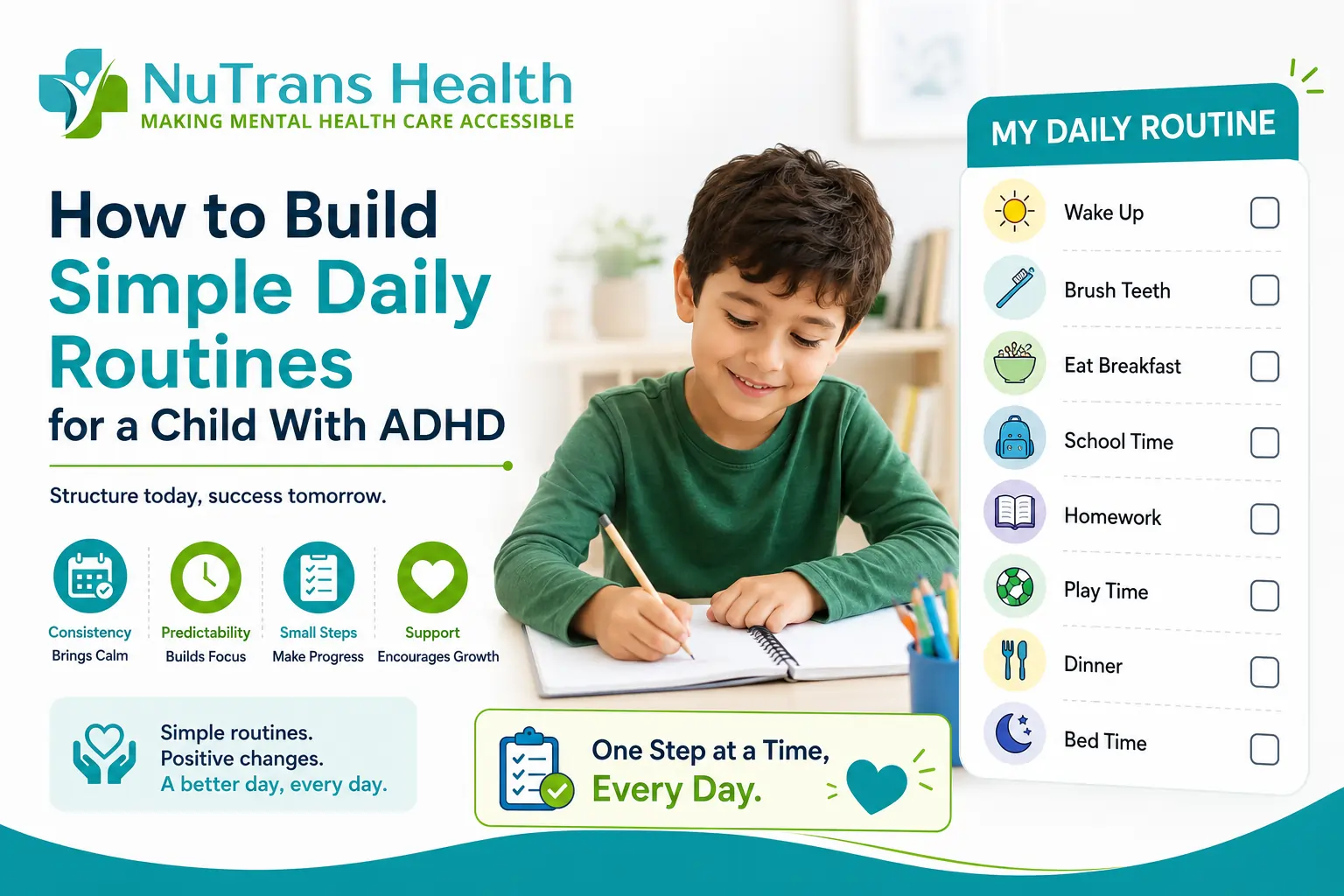
To build routines that genuinely help, it is important to understand why children with ADHD benefit so strongly from consistency and structure.
ADHD is fundamentally a disorder of executive functioning, the brain's management system. Executive functions include the ability to plan ahead, manage time, hold information in working memory, regulate emotions, initiate tasks, and shift flexibly between activities. These are exactly the skills required to navigate a daily routine independently.
When a child without ADHD hears "time to get ready for school," their brain automatically activates a mental sequence: get up, get dressed, eat breakfast, brush teeth, grab a bag, get out the door. The steps feel intuitive because their executive functioning system is running smoothly in the background, keeping track of time, sequencing tasks, and managing transitions.
For a child with ADHD, that same mental sequence is genuinely hard to access. Their internal clock is unreliable, they have little natural sense of how long things take or how much time has passed. Their working memory may not reliably hold the sequence of steps. Their ability to initiate tasks, especially unpleasant or boring ones, is impaired. And their emotional regulation is fragile enough that a small frustration (a missing shoe, a scratchy shirt) can derail the entire morning.
Routine compensates for all of this. When the sequence of the day is externalized, posted on the wall, built into a chart, anchored to consistent times, the child no longer has to rely on their struggling executive functioning system to figure out what comes next. The environment holds the structure, and the child simply follows it.
This is not a crutch. It is an accommodation, the same principle behind a calculator for a child with dyscalculia or glasses for a child with poor vision. You are not doing the work for them. You are removing a barrier so they can do the work themselves.
What Makes an ADHD Routine Actually Work?
Not all routines work for ADHD children. A routine that is too rigid breaks under real-life pressure. A routine that is too loose provides no meaningful structure. Before you sit down to design your child's daily schedule, internalize these foundational principles.
Consistency over perfection. A simple routine followed most of the time is vastly more effective than an elaborate routine followed occasionally. Do not build a schedule you cannot sustain. Build one you can maintain on a tired Tuesday.
Visual over verbal. Telling a child with ADHD what to do next requires them to hold that information in working memory and act on it. A visual chart, checklist, or picture schedule bypasses working memory entirely. The child looks at the chart and knows what to do next without needing a prompt from you.
Fewer steps, more success. Routines for ADHD children work best when they are broken into the smallest possible steps. "Get ready for bed" is not a step; it is a category. "Put on pajamas" is a step. "Brush top teeth, then bottom teeth" is a step. The more granular your routine, the less room there is for the child to get lost between tasks.
Anchor to existing habits. Routines stick most reliably when new behaviors are attached to things the child already does automatically. Brushing teeth after breakfast rather than "sometime in the morning" is far easier to maintain because the trigger is clear and consistent.
Build in flexibility buffers. ADHD routines need built in buffer time, extra minutes between tasks to account for the inevitable delays, distractions, and emotional detours that are part of ADHD life. A morning routine with zero wiggle room is a morning routine that fails regularly.
Involve your child. Routines imposed entirely from above are far less effective than routines built collaboratively. When children with ADHD have a say in how the routine is structured, they feel ownership rather than resentment, and compliance improves dramatically.
The 3 Essential Routines Every Child with ADHD Needs
While routines can be built for any part of the day, three routines form the foundation of a stable, low-conflict daily structure for children with ADHD: the morning routine, the after-school routine, and the bedtime routine. Master these three, and the rest of the day becomes significantly easier to manage.
The Morning Routine
Morning is the highest-stakes routine of the day. The pressure of a fixed departure time, combined with a child whose brain is not yet fully regulated, creates the perfect conditions for conflict. A well-built morning routine transforms this window from a daily battle into a predictable, manageable sequence.
Step 1: Determine the non-negotiables. Write down every task your child needs to complete before leaving the house. For most children this includes: waking up, using the bathroom, getting dressed, eating breakfast, brushing teeth, brushing hair, packing their bag, and putting on shoes. This is your raw material.
Step 2: Work backwards from departure time. If your child needs to leave at 7:45 AM, work backwards. Breakfast takes 15 minutes. Getting dressed takes 10 minutes (with buffer). Waking up and transitioning from sleep takes 10 minutes. You now know what time every step needs to start. Be honest; most parents underestimate how long each task actually takes for a child with ADHD.
Step 3: Create a visual morning checklist. Post this checklist somewhere visible, on the back of the bedroom door, in the bathroom, or on the kitchen wall. For younger children, use pictures alongside words. For older children, a simple numbered list works well. The rule is simple: the child checks off each item as they complete it. They do not ask you what comes next; they look at the chart.
Step 4: Lay out tomorrow tonight. One of the simplest and most powerful morning interventions is a consistent evening preparation habit. Clothes chosen and laid out the night before. Backpack packed and by the door. Anything needed for tomorrow, permission slips, library books, sports equipment, in a designated spot. Every decision made the night before is one fewer decision to make under pressure in the morning.
Step 5: Build in a reward for completing the routine. For many ADHD children, an incentive for completing the morning routine independently, even a small one, like five minutes of screen time or choosing the breakfast music, dramatically improves buy-in. The reward does not need to be large. It needs to be immediate and consistent.
The After-School Routine
The after school window is often underestimated as a source of ADHD related conflict. Children with ADHD arrive home depleted. They have spent the entire school day managing their behavior, suppressing impulses, and holding themselves together in a structured environment. What looks like defiance in the late afternoon is frequently exhaustion and emotional overflow.
The after school routine needs to honor this reality while still providing the structure that prevents the afternoon from dissolving into chaos.
Start with a decompression period. Build in 20 to 30 minutes of unstructured downtime immediately after school before asking anything of your child. This is not rewarding bad behavior; it is recognizing a neurological need. Allow them to have a snack, move their body, play freely, or decompress quietly. Do not make this period contingent on behavior. It should happen every day as a non-negotiable reset.
Follow decompression with homework. Homework immediately after decompression, before the evening settles in and energy drops further, works best for most children with ADHD. Establish a consistent homework time and a consistent homework location that is prepared and ready. The same chair, the same desk, supplies already there, screens put away.
For children who genuinely cannot manage homework right after school, some families find that a brief physical activity break, a bike ride or a short outdoor play period, provides the sensory regulation their child needs before settling into focused work.
Create a simple after school checklist: Unpack bag → Snack → Decompression time → Homework → Free time. Post it visibly. Keep it simple. The predictability of the sequence is what matters.
The Bedtime Routine
Sleep is not a luxury for children with ADHD; it is a clinical priority. Research consistently links poor sleep with worsened ADHD symptoms, emotional dysregulation, and behavioral difficulties the following day. Many children with ADHD already have sleep difficulties as part of their neurological profile, making a consistent, calming bedtime routine especially critical.
Start earlier than you think you need to. Most families begin the bedtime routine too late and then rush through it, which creates the exact kind of pressure and transition difficulty that derails ADHD children. If your child needs to be asleep by 8:30 PM, the routine should begin at 7:45 PM at the latest.
Reduce stimulation progressively. The bedtime routine should function as a gradual wind down, not a sharp stop. Screens off at least 30 to 45 minutes before bed; the blue light from devices actively suppresses melatonin production, making it harder for any child to fall asleep, and children with ADHD are particularly sensitive to this effect. Replace screen time with lower stimulation activities such as a bath, reading together, quiet play, drawing, or listening to calm music.
Build the sequence and stick to it: Screens off → Bath or shower → Pajamas → Brush teeth → One calming activity (reading, audiobook, light conversation) → Lights out. The same sequence, the same order, every night. The predictability signals to the brain that sleep is coming, which makes the transition significantly easier.
Address the "curtain call" pattern. Many ADHD children become experts at delaying bedtime, suddenly hungry, suddenly needing water, or suddenly remembering something urgent to tell you. Preempt this by building a brief "closing checklist" into the routine: water bottle filled, bathroom used, one thing shared about the day. When everything on the closing checklist is done, the routine is over. Hold the boundary warmly but consistently.
How to Introduce Routines Without a Power Struggle
Building the routine is one thing. Getting your child on board is another. Children with ADHD are particularly sensitive to feeling controlled. Routines imposed suddenly and without explanation often meet with resistance that quickly turns the new system into a new source of conflict.
Have the conversation in advance, not in the moment. Choose a calm, neutral time, such as a weekend morning or after a pleasant meal, to talk about the new routine. Frame it as a solution to a shared problem, not a punishment: "Our mornings have been really stressful for both of us. I want to try something different that might make it easier for everyone."
Build it together. Sit down with your child and build the routine collaboratively. Ask them what order makes sense to them. Ask if there are parts of the morning they find particularly hard and why. Let them have input on the visual format of the chart. Do they want pictures, checkboxes, or a color coded timeline? The more ownership they feel, the more willingly they will follow it.
Start with one routine at a time. Attempting to change the morning, after school, and bedtime routine simultaneously is overwhelming for both you and your child. Choose the one that causes the most conflict, often the morning, and focus exclusively there for two to three weeks before introducing another. Partial success built steadily is far more sustainable than making too many changes at once.
Use a trial period framing. Children with ADHD respond well to time-limited commitments. "Let's try this for two weeks and see how it goes" feels manageable and non-permanent. At the end of two weeks, review it together honestly. What worked? What did not? Adjust accordingly.
How Rewards Can Improve Routine Success
Motivation is one of the most complicated aspects of ADHD. Children with ADHD are not lazier than their peers. Their brains are simply wired to respond to immediate rewards far more strongly than delayed ones. A clean room at the end of the week is too distant to motivate consistent daily effort. A small reward at the end of a completed morning routine is immediate enough to matter.
Effective reward strategies for ADHD routines:
Keep rewards immediate.
The closer in time the reward is to the completed routine, the more motivating it will be. A sticker earned right after the morning checklist is complete is more powerful than a weekly prize.
Keep rewards meaningful.
Ask your child what they actually value. Screen time, a favorite snack, choosing the dinner music, an extra story at bedtime, or a small outing on the weekend can all be effective. Different children are motivated by different things, and a reward that means nothing to your child will not change their behavior.
Use a token economy for longer-term goals.
A simple sticker chart or point system allows children to accumulate small daily wins toward a larger goal they care about, such as a special outing, a toy they have been wanting, or an experience they value. Keep the system simple enough to maintain consistently.
Celebrate the process, not just the outcome.
When your child completes their routine, especially in the early weeks, acknowledge it enthusiastically and specifically. "You did your entire morning checklist today without me reminding you once. That is a big deal." Specific praise reinforces the behavior far more effectively than generic approval.
When Your ADHD Routine Starts to Slip
It will. Not sometimes, regularly. A child gets sick and the routine goes out the window for a week. School holidays disrupt the schedule. A stressful period at home unsettles everything. The routine that worked beautifully in October falls apart by December.
This is normal, expected, and not a sign that you have failed or that the routine does not work. It is a sign that you are navigating a real life with a real child.
When the routine breaks down, the goal is not to maintain it perfectly — it is to return to it as quickly as possible. Treat every disruption as temporary. Resist the urge to abandon the system entirely because it did not survive a difficult week. Simply restart it, with the same matter-of-fact calm you would use to restart any other daily habit.
Some children need an explicit re-introduction after a break: "We've been off our routine during the holidays. Starting Monday, we're going back to it." Give advance notice, review the chart together, and begin again.
Recent research is also reshaping how we understand ADHD. Learn more about Types of ADHD: What a New 2026 Study Found, and discover what these findings could mean for children and families.
When to Seek Additional Support
Daily routines are a powerful tool, but they are only one part of managing ADHD effectively. If your child's symptoms continue to significantly impact their functioning at home, school, or in social settings despite consistent routines, or if you as a parent are feeling overwhelmed, exhausted, or unsure how to move forward, seeking professional support may be beneficial.
Mental health professionals can help children and families develop personalized strategies to manage ADHD-related challenges and build skills that support long term success. Depending on your family's needs, support may include:
- Individual therapy for children and adolescents focused on emotional regulation, executive functioning, organization, and independence
- Family therapy to improve communication, reduce conflict, and strengthen relationships at home
- Psychiatric evaluations and medication management when a comprehensive assessment suggests medication may be helpful
- Parent counseling or coaching to provide practical guidance, support, and effective ADHD parenting strategies
- Telehealth services that offer flexible access to care from home
Seeking help is not a sign that you have failed. In many cases, professional support provides families with the tools, insight, and confidence needed to navigate ADHD more effectively and create lasting positive change.
Daily routines become much easier to understand when you recognize how ADHD affects task initiation, organization, and time management. Explore these challenges in ADHD and Everyday Tasks: Why Small Things Can Feel So Hard.
How NuTrans Health Can Support Your Family
No routine will be perfect, and that is okay. Every family goes through periods of trial and error, making adjustments, facing setbacks, and finding new approaches that work better over time. Success does not come from getting everything right on the first attempt. It comes from staying consistent, remaining flexible, and continuing to show up for your child even when things do not go as planned.
At NuTrans Health, we specialize in supporting children, adolescents, and families navigating ADHD, anxiety, behavioral challenges, and more. Whether you are seeking therapy, family counseling, or care from a Psychiatrist in Raleigh, NC, our compassionate and experienced team is here to help your family build a calmer, more connected life.
Schedule an appointment today and take the first step toward creating a more peaceful and supportive home environment.
Related Blogs
Mental Health Services in Raleigh NC and How AI Improves It
Mental Health Services in Raleigh NC and How AI...
Read MoreMental Health Counseling and Workplace Stress in Raleigh
Mental Health Counseling and Workplace Stress in Raleigh The...
Read MoreTeletherapy vs. In-Person Counseling: Which One is Right for You?
Teletherapy vs. In-Person Counseling: Which One is Right for...
Read More